
Find out what's really wrong before you pay to fix it.
A focused, remote diagnostic of one problem area. We check what your self-assessment, or your gut, says against your actual records and how the work really runs. Then you get a written call: what's causing it, what to fix first, what to leave alone, and whether bigger work is worth paying for.
I know something is holding us back. I need to know what to fix first.
-
Send us the contextA short form: what's stuck and the decision you're facing. A person reads it.Start here
-
We confirm it fits, then you orderIf the Inspection is the right step, we set up the $2,500 order. If it isn't, we say so.
-
Records, a conversation, then the written callCause versus symptom, what to fix first, and a 90-day path.
Starts with a short form. A person reads it, not a sales sequence.
- $2,500Flat. Paid once through Stripe.
- 1 areaOne problem area, checked in depth.
- RemoteYou send records; we talk it through.
- 5 partsMap, evidence, cause, moves, and the call.
- ~1 weekClarification meeting to strategy document.
Order the Inspection.
- One problem area, checked against your actual records.
- Remote. You send what you already keep; we talk it through.
- A written strategy document and a straight call on what to fix first.
- On-site or deeper work is scoped and priced separately, before anything moves forward.
Order the Inspection.
$2,500 through Stripe. We start intake from your order and any self-assessment you've taken.
What a Business System Inspection is.
A Business System Inspection is a $2,500 remote diagnostic of one problem area in an owner-led business. SweetSpot reviews your records and talks through how the work actually moves, then gives you a written strategy document: the likely root cause versus the visible symptom, what to fix first, what to leave alone for now, a 90-day path, and whether deeper work is worth paying for.
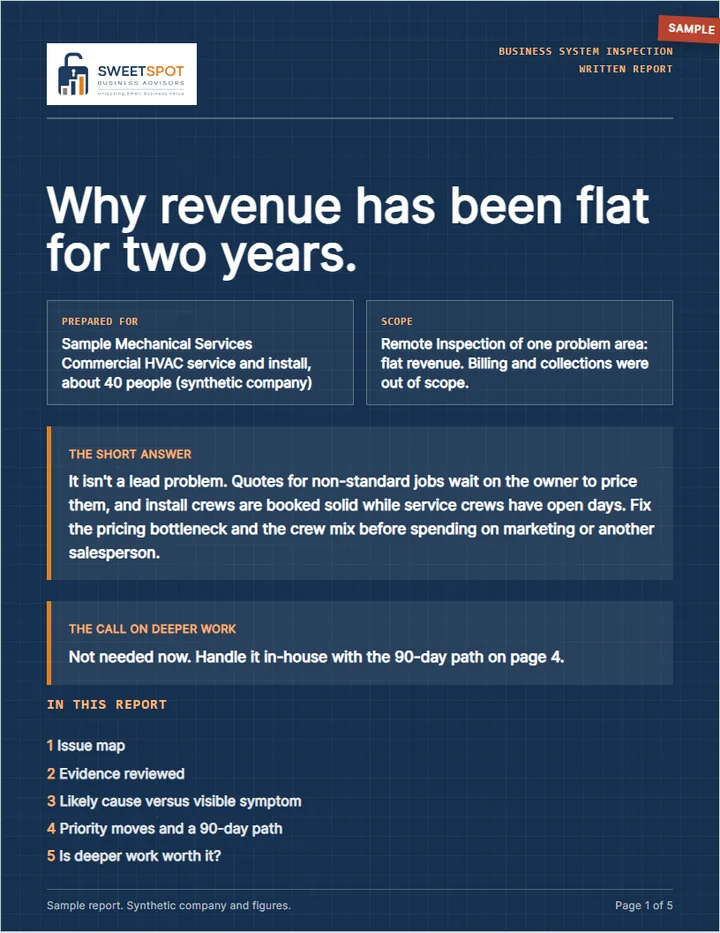
Read a sample Inspection report.
Five pages, written for a sample company whose owner was sure the problem was leads. It wasn't. Your strategy document follows the same format, built from your own records and conversations.
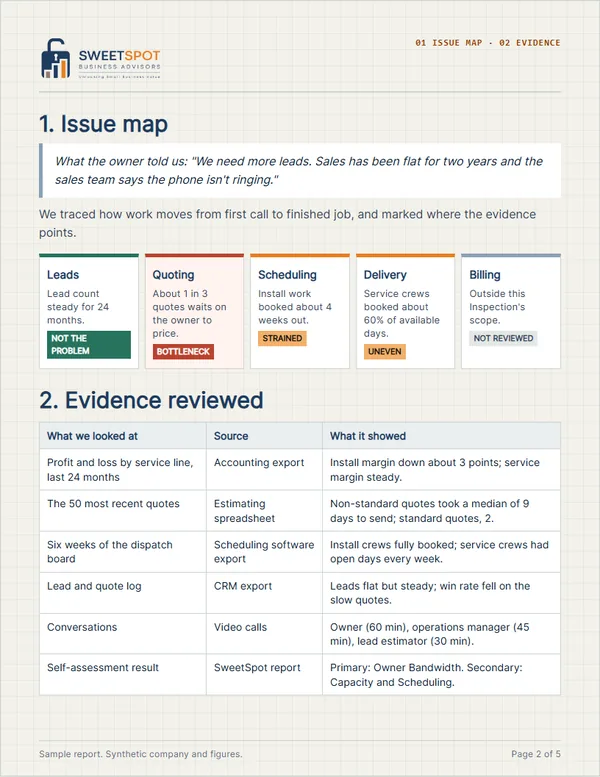
Page 2The issue map and the evidence behind it 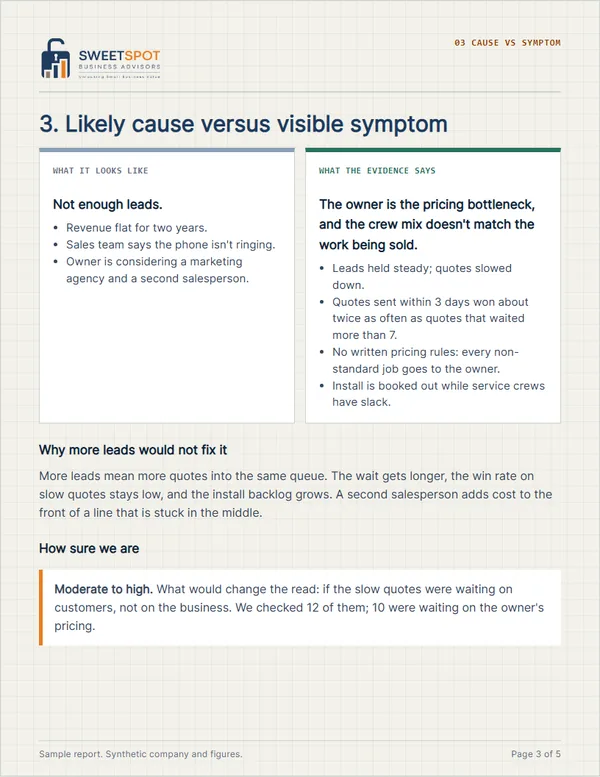
Page 3Cause versus symptom, and how sure we are 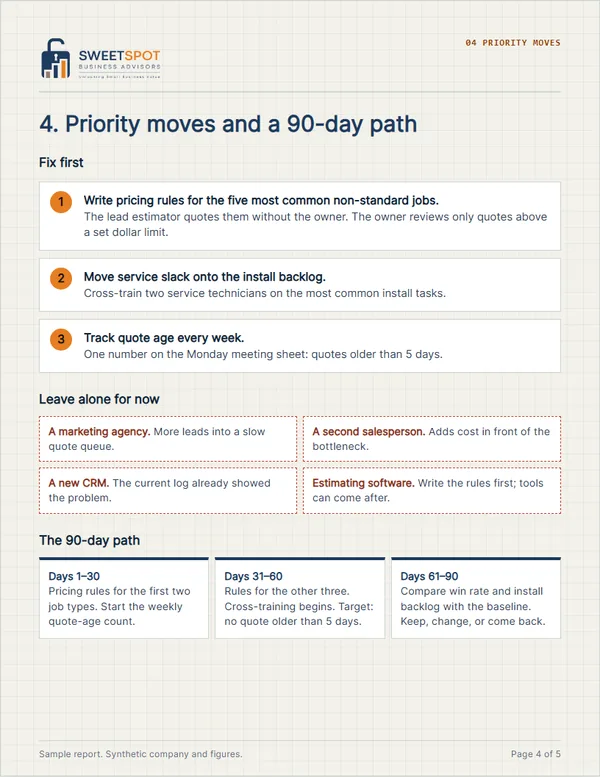
Page 4Fix first, leave alone, and the 90-day path 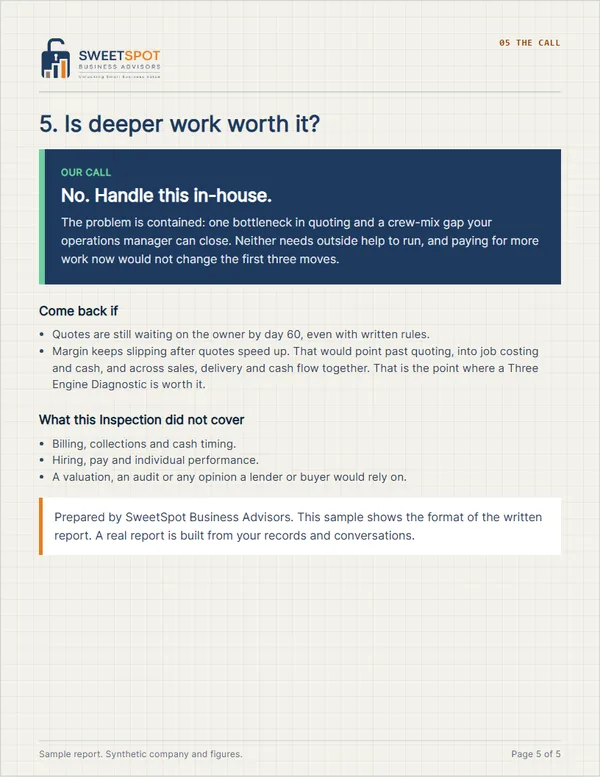
Page 5The call, even when it's "handle it yourself"
Sample only: the company, people and figures are invented for illustration. It is not a client report.
The symptom and the cause are often in different places.
Guess wrong and you pay for the fix twice: once for the wrong one, then again for the right one.
The owner couldn't leave for more than a short trip. Every exception came to his phone.
Nobody else had defined authority. Decision rights, escalation and phone routing all ran through the owner.
Another manager hired into the same fog: a salary added, and the exceptions still route to the owner.
After work on decision rights, leadership accountability, phone routing and a scorecard, the owner went from short trips to a full week away while the business kept running.
Sales are flat. The team says it needs more leads.
Capacity. The schedule is already full, or quotes sit in a queue, so more demand can't become more jobs.
A marketing push into a full schedule: more quotes you can't deliver on time, a lower win rate and a strained crew.
Busy every week, but profit keeps slipping.
Margin leaking between the quote and the final number, in numbers nobody sees early enough to act on.
More volume at the same leaky margin, or software bought to replace judgment. The leak gets bigger and harder to see.
The Inspection finds that connection before a bigger fix gets sold to you, including a bigger fix from us. Sometimes the right answer is a short list your own team can handle, and the strategy document will say so.
Starts with a short form. A person reads it, not a sales sequence.
How the Inspection differs from the Field Guide.
The Field Guide gives you tested answers to the pattern your self-assessment found. The Inspection looks at your business itself.
| Compare | Field Guide$250 · you do the work | Business System Inspection$2,500 · we look at your business |
|---|---|---|
| Who looks | You, with a written guide built from your self-assessment answers. | We review your actual records and talk with you and, where it helps, the people who do the work. |
| Built from | Tested answers to the pattern your answers show. | Your business. Custom, not pattern-based. |
| What it finds | Where to look first, and the smallest fix worth testing. | The likely cause behind the symptom, with the evidence that supports it. |
| Best for | Familiar, narrow, reversible problems. | Urgent, high-stakes or tangled problems. |
| You get | A 90-day plan and worksheets to run yourself. | A written strategy document and a straight call: what to fix first, what to leave alone, and whether bigger work is worth it. |
Choose the Inspection when:
- You're about to hire a manager, an operations lead or another salesperson to fix it.
- You're changing prices, dropping a customer or rebidding major work.
- A sale, a buyer's questions or a lender's review is on the calendar.
- You've already tried the obvious fix, and it didn't stick.
- The problem runs through money, people and customers at the same time.
- You're weighing an acquisition, financing or an internal buyout.
Starts with a short form. A person reads it, not a sales sequence.
Get started, send what you have, get the call.
Get started.
Send the context. If the Inspection is the right step, we set up the order.
Intake.
We read your self-assessment if you have one, the pain you can see, and the decision you're trying to make.
Evidence and conversation.
We ask for specific records and talk through how the work actually moves, with you and, where it helps, the people who do it.
The strategy document.
The issue map, the evidence, the likely cause versus the symptom, priority moves with a 90-day path, and the call on deeper work. From our clarification meeting to your strategy document: about a week.
Messy books and rough tracking are normal; finding what they hide is part of the job.
$2,500 covers a standard remote Inspection of one problem area. If your business needs on-site work, several team interviews or a deeper document review, we scope and price that separately before anything moves forward.
Starts with a short form. A person reads it, not a sales sequence.
Is the Inspection the right step?
It fits when
- You run an owner-led company, usually $1 million to $50 million in revenue, mostly in Texas.
- You know roughly where it hurts, but not why.
- The next decision is expensive: a key hire, new software, a pricing change, sale preparation or a deal.
- You're willing to share real numbers and examples, so the recommendation means something.
Skip it when
- You want general education. The $250 Field Guide is the cheaper tool for that.
- You want a rubber stamp for a fix you've already chosen.
- You need a valuation number, an audit or a quality of earnings report.
- You want a software recommendation before anyone has looked at the work.
Operators, not theorists.

SweetSpot was founded by Daniel Sweet: 27 years in technology, consulting, sales and management with full P&L responsibility, at Apple, IBM, Compaq, HP and resellers serving Fortune 500 companies. Since 2019 he has bought and grown Texas small businesses through Sweetview Partners, and he has advised on more than $250 million in sale and purchase deal value, on both sides of the table.
Your Inspection is performed by a SweetSpot consultant. SweetSpot Business Advisors · Houston, Texas.
When the Inspection shows the problem runs across the business.
Sometimes the evidence crosses everything at once: how work is sold, how it gets delivered and how it turns into cash. Fixing one area at a time won't hold. That is what the Three Engine Diagnostic is for.
- One full working day on site at your business, plus travel. Not remote, and not a multi-week project.
- The whole business in three passes: your sales process, your delivery and your cash flow, walked with the people who run each one, including about an hour alongside your staff on the job.
- A sit-down readout by the end of the day: the main constraint named, and a prioritized set of moves, each with an honest call on who should do it: you, us, or another firm. A written report follows.
- Delivered by a SweetSpot advisor from our consultant bench, working under Daniel's direction.
How the Inspection feeds it
The last page of your strategy document makes the call on deeper work, and says why. If it recommends the Diagnostic, the day starts from what the Inspection already found instead of from scratch. If the problem is contained, you keep the work in-house, and the strategy document tells you so.
Starting at $4,750, plus travel.
See the Three Engine DiagnosticQuestions owners ask about the Inspection
What is a Business System Inspection?
A focused, remote diagnostic of one problem area in an owner-led business. SweetSpot reviews your records and talks through how the work actually runs, then gives you a written strategy document: the likely root cause, what to fix first, what to leave alone for now, and whether bigger work is worth paying for. It costs $2,500.
How much does a Business System Inspection cost?
$2,500, paid through Stripe when you order. That covers a standard remote Inspection of one problem area. If your business needs on-site work, several team interviews or a deeper document review, we scope and price that separately before anything moves forward.
Is the Inspection remote or on site?
Remote. You send records and we talk it through. If you want someone walking your operation, that is the Three Engine Diagnostic: one full working day at your business, starting at $4,750 plus travel.
What will I need to send?
What you already keep. Usually: recent financial reports, and margin by job or service line if you have it; schedule examples; sample estimates or quotes; lead and quote tracking, however rough; current roles and who really decides what; and your self-assessment report if you took one. Messy books and rough tracking are normal; finding what they hide is part of the job. After you order, we tell you exactly what to send for your situation.
Messy books and rough tracking are normal; finding what they hide is part of the job. After you order, we tell you exactly what to send for your situation.
How long does the Inspection take?
About a week, measured from the clarification meeting (where we go over your goals, the problem, the details and our questions on the documents you sent) to the delivered strategy document.
What do I get at the end?
A written strategy document: the issue map for your situation, the evidence reviewed, the likely root cause versus the visible symptom, priority recommendations with a 90-day path, and a straight call on whether deeper work is worth it, including when the answer is to handle it yourself. See a sample report.
Do I need to buy the Field Guide first?
No. The $250 Field Guide is the lower-cost step when you're ready to do the work yourself. Go straight to the Inspection when the issue is expensive, urgent or tangled enough to need someone checking your actual records.
How is this different from a valuation, an audit or a quality of earnings report?
Those put a number on the business or verify its financial statements, and buyers and lenders rely on them. The Inspection looks at how the work actually runs, the handoffs, pricing, decisions and cash visibility, to find what's holding the business back. It doesn't produce a valuation or a report a lender will rely on.
Will this turn into a big consulting project?
Not by default. If deeper help makes sense, the strategy document says what it is and what it would take. If it doesn't, the useful answer may be a short list of things your team can do.
How is the Inspection different from the Three Engine Diagnostic?
The Inspection is remote, looks at one problem area, and costs $2,500. The Three Engine Diagnostic is one full working day on site, looks across your sales process, delivery and cash flow, and starts at $4,750 plus travel. Start with the Inspection when you know roughly where the problem is.
Check the problem against the real business before you spend on the fix.
Starts with a short form. A person reads it, not a sales sequence.