
● TEXAS VALUATION & BUSINESS VALUE · OILFIELD, MIDSTREAM & ENERGY SERVICES
What a Texas Oilfield, Midstream, or Energy Services Business Sells For
Owner-led Texas oilfield, midstream, and energy services companies commonly sell for ~2.0x–3.4x through-cycle Seller’s Discretionary Earnings (SDE) on smaller field-service operations, and ~3.0x–5.2x normalized Adjusted EBITDA (often evaluated alongside 4.0x–6.5x EBITDA minus maintenance CapEx or orderly liquidation value of rolling stock plus a goodwill multiple) for established operators with active Master Service Agreements (MSAs), production/midstream recurring work, and clean safety records across the Permian Basin, Eagle Ford, Haynesville, and Houston Energy Corridor (sources: IBBA / M&A Source Market Pulse Q4 2025, BizBuySell 2021–2025 benchmarks, Pepperdine Private Capital Markets Report, and lower-middle-market OFS transaction comps, checked ).
These are published market ranges, not a valuation of your business; a formal valuation requires a credentialed appraiser (when you need a formal appraisal). SweetSpot is not a broker. We don’t list businesses, find buyers or take a success fee. We work inside Texas oilfield and energy services businesses 1–3 years before an exit so you diversify operator concentration, document MSA & ISNetworld compliance, and get field dispatch off the founder’s phone.
See the worked oilfield valuation exampleCompare what moves an OFS multiple · Texas OFS guide · Permian Basin · published fees.
Texas Energy Services.
Basin & Exit Guides.
Related Texas basin guides & exit-planning hubs:
Texas Oilfield ServicesPermian BasinEagle FordHaynesvilleBarnett ShaleHouston exit planningSan Antonio exit planningWhat It CostsILLUSTRATIVE WORKED EXAMPLE — NOT A FORMAL VALUATION
How a buyer calculates through-cycle EBITDA, maintenance CapEx, and implied price on a Texas oilfield services company
Unlike low-asset service businesses, oilfield and midstream contractors require continuous investment in heavy trucks, pumps, hydrovacs, or testing units. Sophisticated buyers never price a cyclical peak year in isolation — they weight 3-year through-cycle Adjusted EBITDA and check Free Cash Flow (EBITDA minus annual maintenance CapEx) along with the fair market value of unencumbered equipment (see full SDE vs. EBITDA guide).
Table A — Illustrative Earnings & Free Cash Flow Build ($8.5M Revenue Permian / Eagle Ford Production & Midstream Contractor)
Illustrative, not a formal valuation. Shows how energy-services buyers normalize 3-year earnings and test fleet replacement CapEx.
| Line item | Amount | How energy-services buyers and lenders treat it |
|---|---|---|
| Reported pre-tax net income (3-year weighted average) | $820,000 | Buyers weight the trailing 36 months so a single spike or dip in WTI/rig activity does not distort baseline earnings. |
| + Book depreciation & equipment interest expense | +$640,000 | Added back to compute EBITDA, including Section 179 / bonus depreciation taken on field trucks and heavy iron. |
| + Owner W-2 compensation & verified personal add-backs | +$290,000 | Added back for SDE; replaced by a market-rate Operations VP / District Manager salary for Adjusted EBITDA. |
| = Through-Cycle Seller’s Discretionary Earnings (SDE) | $1,750,000 | Total pre-debt, pre-CapEx cash flow available to a working owner. |
| − Market replacement cost for District Operations Manager | −$190,000 | Required if the founder currently handles operator MSA renewals, field pricing, or yard dispatch. |
| = Normalized Adjusted EBITDA | $1,560,000 | Headline earnings base (~18.4% EBITDA margin) before maintenance CapEx review. |
| Memo: Annual recurring fleet & tool maintenance CapEx | −$360,000/yr | Buyers check whether EBITDA minus maintenance CapEx ($1,200,000) supports debt service and return on capital. |
Table B — Illustrative Multiple Applied by Contract & Fleet Profile (Low / Median / High)
Illustrative, not a formal valuation. Shows how operator concentration, MSA standing, and production vs. drilling exposure shift the multiple on $1,560,000 Normalized EBITDA.
| Readiness profile | Earnings base used | Illustrative multiple | Implied enterprise value | Why it lands here |
|---|---|---|---|---|
| Low (Spot drilling / concentrated / deferred fleet CapEx) | $1,560,000 EBITDA | 2.6x EBITDA | ~$4,056,000 | Two operators represent 65% of revenue, work is tied to new drilling completions, and fleet needs $700K in immediate catch-up CapEx. |
| Median (Established basin production-services contractor) | $1,560,000 EBITDA | 3.6x EBITDA | ~$5,616,000 | 70%+ production/LOE maintenance work, 8+ active MSAs with Grade-A ISNetworld/Veriforce standing, well-maintained fleet. |
| High (Midstream / I&E / environmental with multi-basin MSAs) | $1,560,000 EBITDA | 4.7x EBITDA | ~$7,332,000 | Multi-year midstream/plant maintenance & measurement contracts, low CapEx intensity, TRIR 0.4, runs without the owner for 90 days. |
WHAT MOVES THE MULTIPLE
Six factors that push a Texas oilfield or midstream multiple up or down
Before you talk to a broker (see what to fix before hiring a broker), strategic energy buyers and private equity acquirers test your operation across these six basin-specific drivers.
| Driver | Pushes the multiple up (3.8x–5.2x+ EBITDA) | Pushes it down (~1.8x–2.7x EBITDA or equipment auction value) |
|---|---|---|
| 1. Active MSAs & ISNetworld / Veriforce / PEC Standing | 10+ transferable Master Service Agreements with major & independent E&P or midstream operators, backed by continuous “A” safety grades. | Working as an unapproved sub-tier vendor or letting ISNetworld/Veriforce compliance and insurance endorsements lapse. |
| 2. Production (LOE) & Midstream vs. Drilling Exposure | 75%+ of revenue tied to existing producing wells, saltwater/water handling, compression, pipeline integrity, or plant I&E maintenance. | 100% exposure to spot drilling rig counts or completion callouts that vanish when commodity prices dip. |
| 3. E&P Operator Concentration & Consolidation Risk | No single operator exceeds 15%–18% of revenue, and relationships are held with multiple field superintendents and procurement leads. | One E&P company accounts for 45%+ of billings — if that operator merges in a Permian consolidation, the contract can disappear overnight. |
| 4. Fleet Age, DOT Records & Maintenance CapEx | Documented preventative maintenance logs, DOT compliance, unit-level utilization tracking, and staggered replacement CapEx. | Deferred engine/pump rebuilds and aging trucks that force a buyer to inject $500K–$1M of CapEx right after closing. |
| 5. Safety TRIR, EMR & Environmental Record | Three-year Total Recordable Incident Rate (TRIR) under 1.0 and Experience Modification Rate (EMR) below 0.85, managed by a dedicated HSE lead. | Elevated EMR above 1.0, OSHA citations, or undocumented spill/environmental liabilities that disqualify the company from operator bid lists. |
| 6. Field Supervision Depth & Ticket-to-Invoice Cycle | District manager, dispatchers, and field pushers run crews independently; field tickets are approved digitally in OpenInvoice/Oildex within 48 hours. | Company men only call the founder’s cell phone, and paper field tickets sit in truck cabs for 30 days, inflating DSO and trapping working capital. |
WHY SWEETSPOT, AND NOT A BROKER
We help you build a transferable energy services business before you go to market.
In Texas oilfield and industrial services, a broker can package your tax returns, but a broker will not get your field tickets into digital billing faster, build a second-line superintendent bench, or reduce your dependence on a single Permian or Eagle Ford operator before buyers look under the hood.
Whether you run crews out of Midland–Odessa, Karnes City, Kilgore, or Houston, our job is to make your business hold up in diligence and run without you — for fixed, published fees (see What It Costs) and zero success fee.
Model your deal: Asset vs. Stock Sale & Section 1245 Equipment Recapture · Working Capital Peg Guide · Seller Net Proceeds Calculator →
FREQUENTLY ASKED QUESTIONS
Texas oilfield, midstream & energy services valuation questions.
What is a Texas oilfield or energy services business worth?
Smaller owner-operated Texas oilfield services companies commonly sell for roughly 2.0x to 3.4x through-cycle Seller’s Discretionary Earnings (SDE), while larger contractors with active MSAs, production or midstream recurring work, and field management commonly trade at 3.0x to 5.2x normalized Adjusted EBITDA, based on published 2025–2026 benchmarks. Buyers also evaluate EBITDA minus annual maintenance CapEx and fair market equipment value.
How do buyers value heavy trucks and oilfield equipment in a sale?
In standard lower-middle-market transactions, operating equipment and rolling stock are included inside the enterprise value multiple rather than added on top of it — the fleet is what generates the EBITDA. However, a strong fair-market orderly liquidation value (OLV) sets a floor on valuation and helps buyers finance the deal, while an aging fleet with deferred maintenance triggers a dollar-for-dollar CapEx deduction in diligence.
Why does Section 1245 depreciation recapture matter so much for oilfield sellers?
Most Texas oilfield contractors use Section 179 or bonus depreciation to write their trucks, pumps, and heavy equipment down to $0 tax basis. In an asset sale, when the buyer allocates purchase price to that fleet at fair market value on IRS Form 8594, the gain above your $0 tax basis is taxed as ordinary income (up to 37% federal) rather than 20% long-term capital gains (see our Asset Sale vs. Stock Sale Texas Guide).
Do Master Service Agreements (MSAs) automatically transfer to a buyer?
Not always. In an asset sale, many E&P and midstream MSAs require written operator consent to assign the contract, whereas in a stock sale or F-reorganization the legal entity holding the MSA remains unchanged (though some MSAs still contain change-of-control notice clauses). Reviewing your top 10 MSAs 12 months before market prevents closing delays.
How do 60-to-90 day operator payment terms affect my closing cash?
Because E&P operators often take 45 to 90 days to approve tickets in OpenInvoice and pay invoices, oilfield service companies carry large Accounts Receivable and unbilled field-ticket balances. In a cash-free, debt-free sale, that working capital must stay in the business to meet the 12-month Net Working Capital peg (see our Working Capital Peg Calculation Guide).
Are you a business broker or equipment appraiser?
No. SweetSpot is not a business broker and not a certified machinery or business appraiser — we do not list companies, auction iron, or take a closing commission. We are operator-led advisors who help you diversify customer risk, tighten ticket-to-cash cycles, and build management depth for fixed, published fees so you sell from strength.
24-PAGE FIELD GUIDE SAMPLE · OILFIELD SERVICES ($9.2M)
See what a completed 24-page Field Guide looks like for Oilfield Services ($9.2M).
MSA field work · Permian / Eagle Ford / Haynesville / Barnett · 42-person crew & fleet
- Cut MSA field ticket dispute & DSO drag by tightening daily sign-off and dispatch billing gates
- De-concentrate top 2 E&P operator exposure before a buyer discounts the multiple at diligence
- Hand field dispatch, standby pricing, and crew scheduling to field superintendents with clear rules
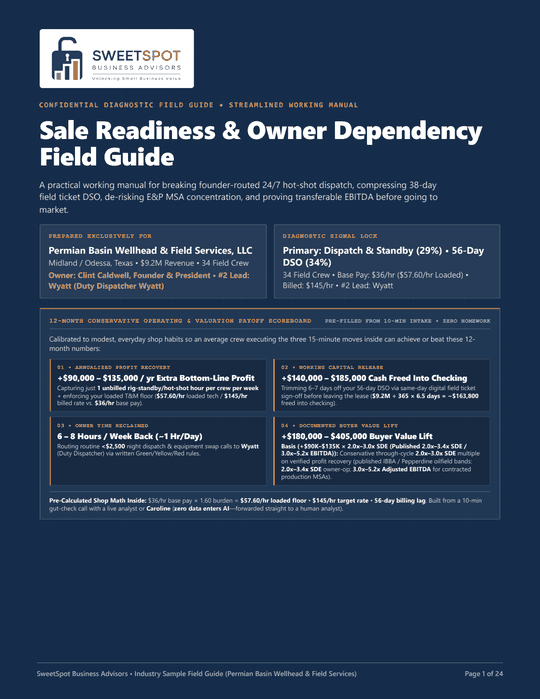
Protected preview · Click to launch the 24-page Oilfield Services ($9.2M) walkthrough