Free Printable Owner & Manager Worksheet · 3 Pages (PDF)

Internal Role Exercise: Get Clear on a Manager’s Real Job & Priorities

When you promote a lead tech, dispatcher, estimator, or shop foreman—or when you and a key manager keep bumping heads over what got dropped—arguments happen because you each have a different picture of the job in your head. Have them fill out these 3 pages based on their actual day-to-day reality (not what they think you want to hear), then sit down for 30 minutes and compare notes.

  • Forces a strict maximum of 5 key responsibilities so you both see what gets dropped when the day gets loud.
  • Maps exact decision authority (what they decide alone vs. what still requires calling your cell phone).
  • Includes 10 skill lines with TRAIN? checkboxes so managers can flag where they need coaching without defensiveness.
  • Built around an explicit Promise of Candor so you get their honest Tuesday-afternoon reality, not an HR template.
Get the free 3-page worksheet

It arrives from SweetSpot Business Advisors in a minute or two. Check your junk folder if you don’t see it.

See our Privacy Policy.

30-Minute Alignment Protocol

How to Run This Exercise Without Starting a Fight

Most small-business job descriptions are either nonexistent or copied from an HR template nobody has looked at since hiring day. This worksheet works because it asks the person sitting in the seat to describe the job as it actually runs on a Tuesday afternoon.

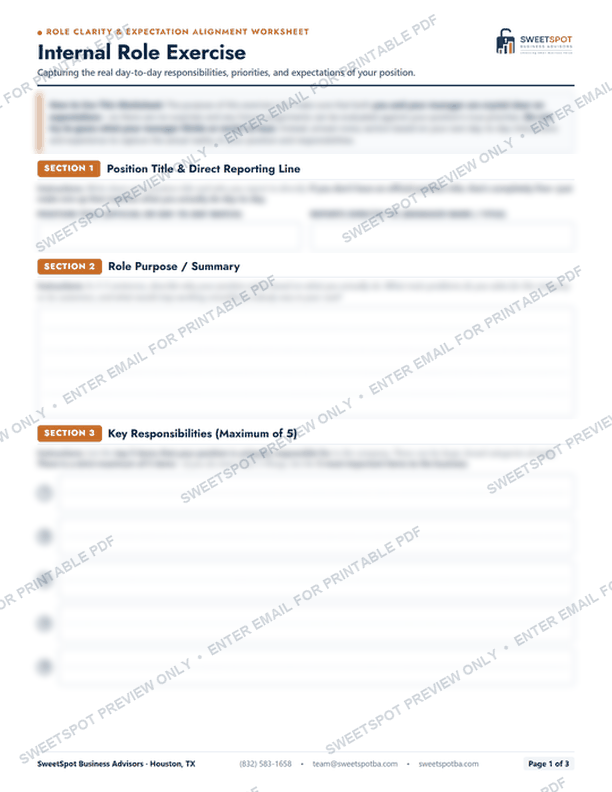
Preview of the SweetSpot Internal Role Exercise 3-page printable Worksheet

3 pages, US Letter, ready to print. Enter your email above and we send the printable worksheet to your inbox right away.

  1. Step 1: Print two blank copies for one key seat Hand one copy to your manager (or lead tech, dispatcher, estimator, or office lead) and keep the second copy for yourself. Tell them to write from their real day-to-day experience, not an idealized corporate version.
  2. Step 2: Fill them out separately (15–20 minutes) Have the manager complete all 9 sections on their copy while you fill out Sections 2, 3, 5, and 6 for what you actually need that seat to own so you can step out of daily firefighting.
  3. Step 3: Compare your Top 5 and Decision Boundaries side by side Look first at Section 3 (Key Responsibilities, capped at 5) and Section 6 (Decision Authority). Whenever an item is on your list of 5 but missing from theirs, you have found a silent drop-off.
  4. Step 4: Agree on 30-day ownership and one training priority Lock in the agreed Top 5 responsibilities, write down which decisions no longer require calling your cell phone, and check one skill in Section 4 (TRAIN?) to build over the next 90 days.

The Ground Rule: Promise of Candor Without Repercussions

Section 8 of the worksheet carries an explicit owner promise: your manager must be able to answer with 100% honesty and zero pushback, penalty, or defensiveness from you. If they tell you the worst part of their job is waiting on you for quotes or getting overruled in front of the crew, thank them—that candor is the only way you find the real bottleneck.

Inside the 3-Page Worksheet

Full Breakdown of All 9 Sections on the Worksheet

Every prompt on the worksheet is designed to surface where authority, priorities, or handoffs are fuzzy before they turn into missed margin or owner burnout.

Section 1 · Page 1

Position Title & Direct Reporting Line

Asks for their official title—or a made-up title that better matches what they actually do all week—plus who they report to directly. When someone writes three different bosses or invents a title like “Chief Fire Extinguisher,” you immediately see why priorities collide.

Section 2 · Page 1

Role Purpose / Summary

In 3 to 5 plain sentences: what problems this seat solves for the company and what stops working smoothly if nobody is in it. Separates activity (being busy all day) from the actual outcome the business pays for.

Section 3 · Page 1

Key Responsibilities (Strict Maximum of 5)

If they do more than 5 things, they may only list the 5 most important to the business. That hard cap prevents a 20-bullet wish list and forces an honest conversation about which responsibilities come first when the day gets loud.

Section 4 · Page 1

Skills & Competencies (Top 10 + TRAIN? Checkboxes)

Lists the 10 skills needed to excel in the seat, paired with a TRAIN? (*) checkbox on every line so your manager can flag where they want coaching, estimating practice, software training, or financial context without feeling like they are admitting failure.

Section 5 · Page 2

How to Know if the Person in This Position Has Been Successful (Maximum of 5)

Captures up to 5 concrete ways strong performance is measured—or what they wish they were judged on. Moves performance reviews out of gut feel and into clear weekly or monthly numbers.

Section 6 · Page 2

Decision Authority & Scope

Maps what decisions they make on their own today, what requires checking with the owner or supervisor first, and where the boundary is unclear. This is the single fastest way to stop routine approvals from routing through your phone.

Section 7 · Page 2

Key Internal Relationships (Up to 10)

Lists the internal roles they hand work off to or depend on (dispatch, estimating, parts/warehouse, billing, field crews) and what each side needs from the other so jobs stop falling through the cracks between departments.

Section 8 · Page 3

Your Candid Perspective (Best & Worst Parts of This Position)

Backed by the explicit Promise of Candor, asks what they enjoy most about the role and what frustrates or slows them down the most. Gives you early warning before a key person burns out or quits.

Section 9 · Page 3

Your Next 3 Years (Job & Career Advancement)

Asks what responsibilities and growth they want over the next three years. Essential before you build a succession plan, promote a field lead into management, or assume someone wants to run the shop when you step back.

Practical Owner Questions

Questions Owners Ask Before Running the Exercise

Is the worksheet free, and how do I get it?

Yes. Enter your name and email in the form on this page and we send you a private download link that stays open for 72 hours. Download and print as many copies as you need for your managers.

Who should fill out the Internal Role Exercise first?

Start with the 1 to 3 people your operation leans on most: your operations manager, service manager, lead dispatcher, chief estimator, shop foreman, or office manager. Have each person fill out a blank copy on their own while you fill out a separate copy for their seat, then compare the two side by side.

Why does Section 3 cap Key Responsibilities at a strict maximum of 5?

When a manager has 14 equal priorities, they have none—they just react to whichever customer or tech yells loudest. Forcing both of you to pick only the 5 most important responsibilities surfaces the exact trade-offs where you think they own gross margin or scheduling while they think their main job is putting out daily field fires.

What if my manager writes down something I disagree with?

That gap is the whole point of the worksheet. Do not correct them or get defensive during the first pass. If they believe they cannot approve a $300 warranty fix without calling you, or if they think their job is quoting when you need them running crews, you have just found why work keeps bouncing back to your phone.

How long does the exercise take?

It takes about 15 to 20 minutes for the manager to fill out the 3 pages by hand, and 30 minutes for the two of you to sit down over coffee and compare answers.

What should we do after we compare notes?

Turn the agreed top 5 responsibilities, decision authority rules (Section 6), and success metrics (Section 5) into their one-page operating agreement, and pick one training box from Section 4 to act on this quarter. If every exception still routes back to your phone after clarifying the seat, test the handoff with our 14-Day Owner Absence Audit or see the Owner Value Overhaul.

When Role Clarity Is Part of a Bigger Owner Bottleneck

Need the Business to Run Without Every Decision Routing Through You?

Clarifying one manager’s seat is the first step. If you want to test whether the shop actually holds together when you step back—or if you want an experienced operator on site for a day to map who owns what across your whole team—pick the step that fits where you are today: